Follow TJ on


Most people are only told they have to go outside of their comfort zone to grow confident or skilled—but not how to do it safely and efficiently. This article fixes that.
You've probably heard that "if you want to grow, go outside your comfort zone."
But although this is the best way to build confidence, that sentence is dangerously incomplete.
You see, it’s entirely possible to go outside your comfort zone in ways that will hurt your confidence, rather than help it.
In fact, most of the time when people say, “I’ve tried challenging myself, but it didn’t help,” or “but it just made things worse,” they’ve unknowingly made this mistake.
Like many, you might’ve been told that everything is either inside of your comfort zone (the things you’re already comfortable with) or outside of it (the things you’re not).
And although that’s technically correct, it’s over-simplified in a problematic way.
You see, outside of your comfort zone are two more zones. And if we don’t know what they are or how they work, we risk triggering our fight/flight/freeze response when we challenge ourselves.
At best, that will send us running away from the challenge or simply not do it, and at worst, it will cause us actual trauma.
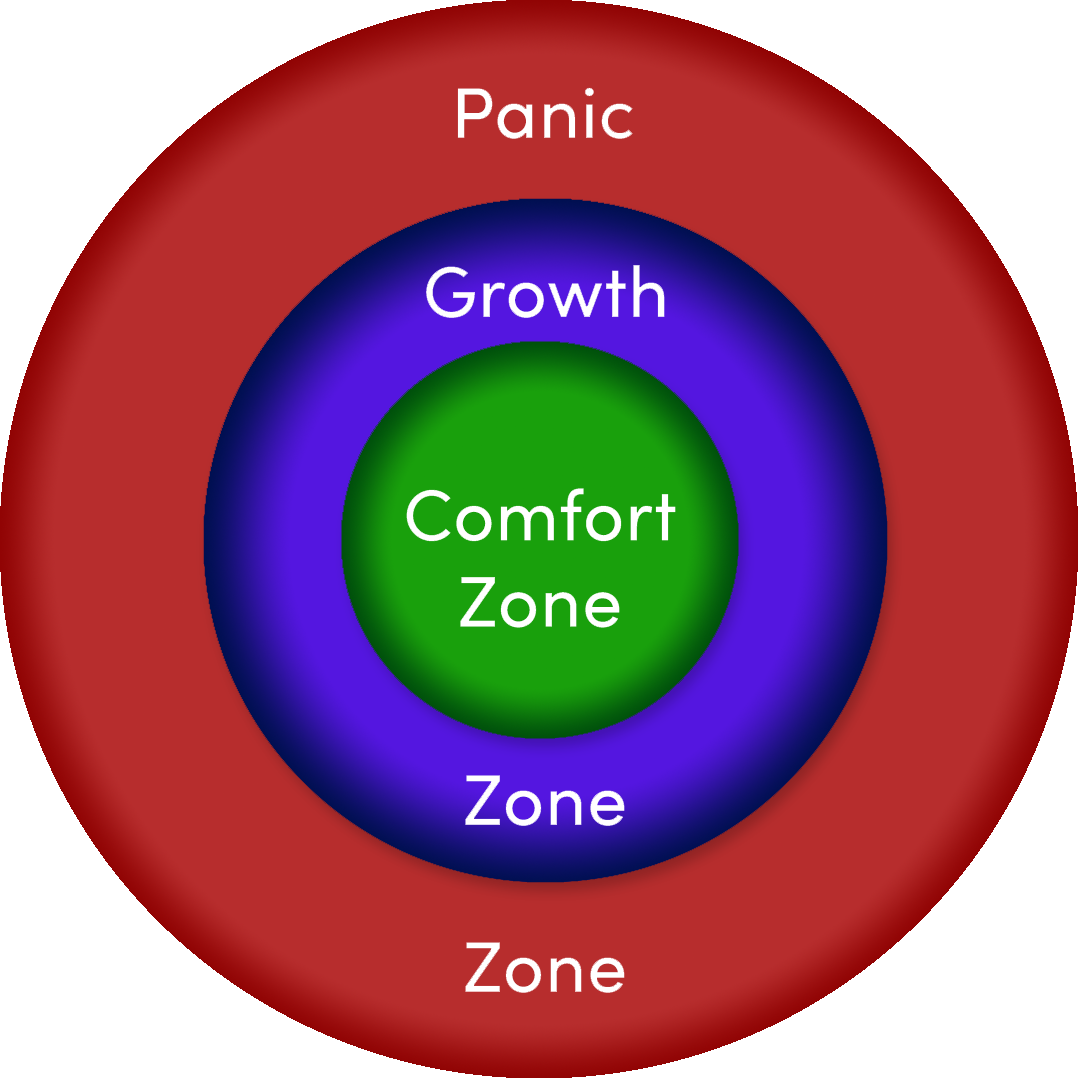
So to avoid that, here’s what the complete model of the comfort zone looks like:
Your Comfort Zone
This is where all the things you can do without feeling stressed or nervous are. It’s a great place to rest and get routine things done, but it rarely provides much growth.
Your Growth Zone
This zone is just outside of your Comfort Zone. Whenever you enter your Growth Zone, you’ll feel nervous, maybe a bit stressed or uncomfortable, but you can still go through with your challenge—at least most of the time.
This is where growth happens. It’s where new skills are learned, and where confidence is built.
Your Panic Zone
Outside of your Growth Zone—way beyond your Comfort Zone—is your Panic Zone.
This is where your logic and reason get overwhelmed by your fight/flight/freeze response. You might have an intense urge to escape, go numb, want to cry, feel physically unwell, or similar severely uncomfortable experiences. And these reactions make learning and growth nearly impossible.
Pushing yourself too hard in this zone can cause real trauma. That trauma tends to make it less likely that you’ll try similar challenges again in the future, and if you do, they will usually be even harder to go through with.
[Continued under image.]
As mentioned, the trick to building confidence is to spend time in your Growth Zone.
If the thing you want to feel confident about is already in there, great! All you have to do is keep practicing it until your confidence and skills get to where you want them.
But what if the thing you want to feel confident about is in your Panic Zone?
In that case, all you have to do is break that thing down into more doable, but still relevant, exercises.
These Growth Zone exercises should lead in the general direction of your end goal and cause you noticeable (but manageable) nerves, stress, or discomfort, without taking you anywhere near a sense of panic.
The general rule of thumb is that exercises you can complete most of the times you try, but not every single time, will give you the fastest progress.
By doing these exercises over and over again, you’ll become more and more comfortable with them until they eventually slip into your comfort zone. When that happens, you’ll find that some of the things that were previously in your panic zone have now moved into your growth zone, and you can safely start practicing those.
This is, whether we’re aware of it or not, how we’ve learned to become skilled and confident with most things in life. And now that you can consciously determine whether something falls in your Growth Zone, you can make that process repeatable—as well as safer, easier, and more effective.
I recently received the text below in an email from someone who had finished my course “Confidence: How to Overcome Self-Doubt, Insecurity, and Fears.”
It’s a perfect example not just of how to do what this article has talked about, but also how to incorporate it into an everyday routine, so I asked for permission to share it with you all.
(I’ve removed his personal details and questions, but otherwise this is his text as he wrote it.)
—
I decided I wanted to be comfortable talking to strangers after getting a job in sales. Before that only felt ok if I was introduced to them socially or if they were a customer at work (and even then it was a little uncomfortable unless they made eye contact with me first). But walking up and talking to random strangers sounded insane and was definitely in my panic zone, so I knew I had to start smaller.
I followed your suggestion and thought about what I could do that was a little more than what I normally did around strangers (nothing) and figured I could try to get eye contact and say hello to people in public. So I did that on my work commute and at the supermarket and it became comfortable faster than I expected.
I decided next I would ask a question like how’s it going? or how are you? You know, typical pleasantries. But after doing it a few times it didn't feel very different than saying hi, since I still just did it in passing and never waited for an answer.
I knew the next step had to be to ask a real question and wait for an answer but just walking up to a stranger to ask them something was still too scary. But I thought that if I happened to be standing next to someone it’d be easier to ask a real question since it would feel more natural in a way.
The first time I tried was in a long line for the cashier at my supermarket. I looked at the guy behind me and asked, is it always this busy here? He said something about it being unusual, and I think I just nodded and turned back to my cart. But it was a start.
Over the next couple of weeks, I kept asking questions to people who happened to be around me (a few times I even pretended to have a reason to stand near them, like looking at the same shelf at the store). Some of my questions were things I had come up with at home like asking if they knew if the product I was looking at was good, but sometimes questions would come to me in the moment too.
After a bit I started adding follow-up questions instead of just saying thanks and leaving. First one follow-up, then two. At least when the strangers appeared nice or talkative. And wouldn’t you know it? Without meaning to, some of these became actual conversations. I’ll admit that at first this happened because the people I talked to were extra talkative, but since I initiated them I felt like they still count!
Anyway, now it’s super easy to talk to customers and I’ve noticed privately too that as long as someone I’m around seems in a good mood I can often strike up a conversation with them.
—
Please remember that this only works if you actually do your exercises regularly over time.
Be aware that fear and discomfort will give you plenty of “reasons” not to go through with the exercises when you’re about to do them. These excuses will often be things you hadn’t thought of when you planned the exercise, and feel pretty convincing. But as long as you know you’re not in your Panic Zone or doing something unsafe, your job is to ignore those excuses and do what you had planned to do.
Accept that you’re going to feel nervous before and during. And when you no longer do, you’ll know that it’s time to increase your challenge enough that the nerves come back, because that’s when you grow.
Remember, confidence isn't built by waiting until you feel ready—it's built by taking action despite not feeling ready.
In fact, it’s not going too far to say that true, core confidence isn't the absence of nerves or stress—it's knowing you can do what needs doing even when those feelings show up.
All the best,
TJ
PS: Want to learn a little more about how to do this?
Check out this video from my course “Confident Communication for Introverts.” (And yes, this video is relevant to extroverts too!)
.svg)


Hi, I'm TJ Guttormsen.
Since 2009 I’ve coached clients ranging from Olympic gold medalists and billionaires, to people who simply want more out life.
I’ve done over 100 national media appearances, published books, and created online courses that have earned several “Highest Rated” titles from their 11 000+ members.
Today I coach clients from all over the world, and teach seminars for business and events from my home in Las Vegas.
Come join me in my Facebook group, follow my Instagram, or subscribe to my YouTube channel for fresh content on a regular basis.

