Follow TJ on


Being able to predict how someone will behave can help us plan better, reduce stress, and feel more confident. So let's talk about the best ways to do it.
How often do you wonder or worry about how someone else will behave or react?
Most of us do it more than we realize.
We worry about how someone will react to bad news, what our boss will say when we’ve overslept, what our friends will think of our new haircut, and a million other things.
Luckily, there are three simple techniques that can help us predict someone’s future behavior surprisingly accurately, depending on whether it’s a familiar situation, a rare situation, or a situation we’ve never seen them in.
Let’s start with the most accurate and work our way down.
If we’re wondering how someone might react in a situation that we’ve seen them in many times before, the answer is as simple as it is obvious:
How they’ve behaved in the past is most likely how they’ll behave now.
Studies have found that this correctly predicts how someone will act roughly 80% of the time for behaviors people do regularly.
The important thing is to make sure you don’t focus too much on an individual example just because it was memorable or recent, but instead consider people’s typical behavior. In other words, you need to think of as many examples as you can and make your prediction based on all of them.
But what if it’s something that happens so infrequently that you can’t think of enough reliable examples?
In these cases, your best bet is to predict behavior based on the person’s conscious intent—or similar-enough situations.
If you’re turning in a report late for the first time in years, the best predictor won’t be what your boss did back then, but how they’ve said they’ll respond to mistakes or missed deadlines—or how they’ve acted in analogous situations.
A massive meta-analysis of 422 studies involving over 82,000 people showed that people’s stated intentions correctly predicted their behavior in roughly 75% of cases.
So if your boss has said that the occasional mistake is understandable, you should expect an understanding reaction. And if they’ve said they’re going to treat any mistake as a vulgar insult to their beloved grandmother, you’d better take cover.
Alternatively, considering how your boss has reacted to other types of mistakes can be equally helpful.
Accuracy here depends on how similar those other situations are to your current one, but if you average your boss’s reactions to mistakes of similar magnitude, accuracy can climb to around 70-80%.
Lastly, if you’re facing a brand new situation with someone who you don’t know particularly well, the best way to accurately predict their behavior is to consider their general dispositions.
In brief, if you’re dealing with a person who is generally positive, supportive, or similar, you can expect that kind of reaction in most situations that aren’t likely to have a significant emotional impact on them.
This is the least accurate method of the bunch, but still slightly better than a coin flip at about 65% accuracy.
As you can probably tell by now, when wondering how someone will behave, you should ignore what you hope or fear they’ll do, what you think they should do, or what you would do.
What matters is what we know about the other person.
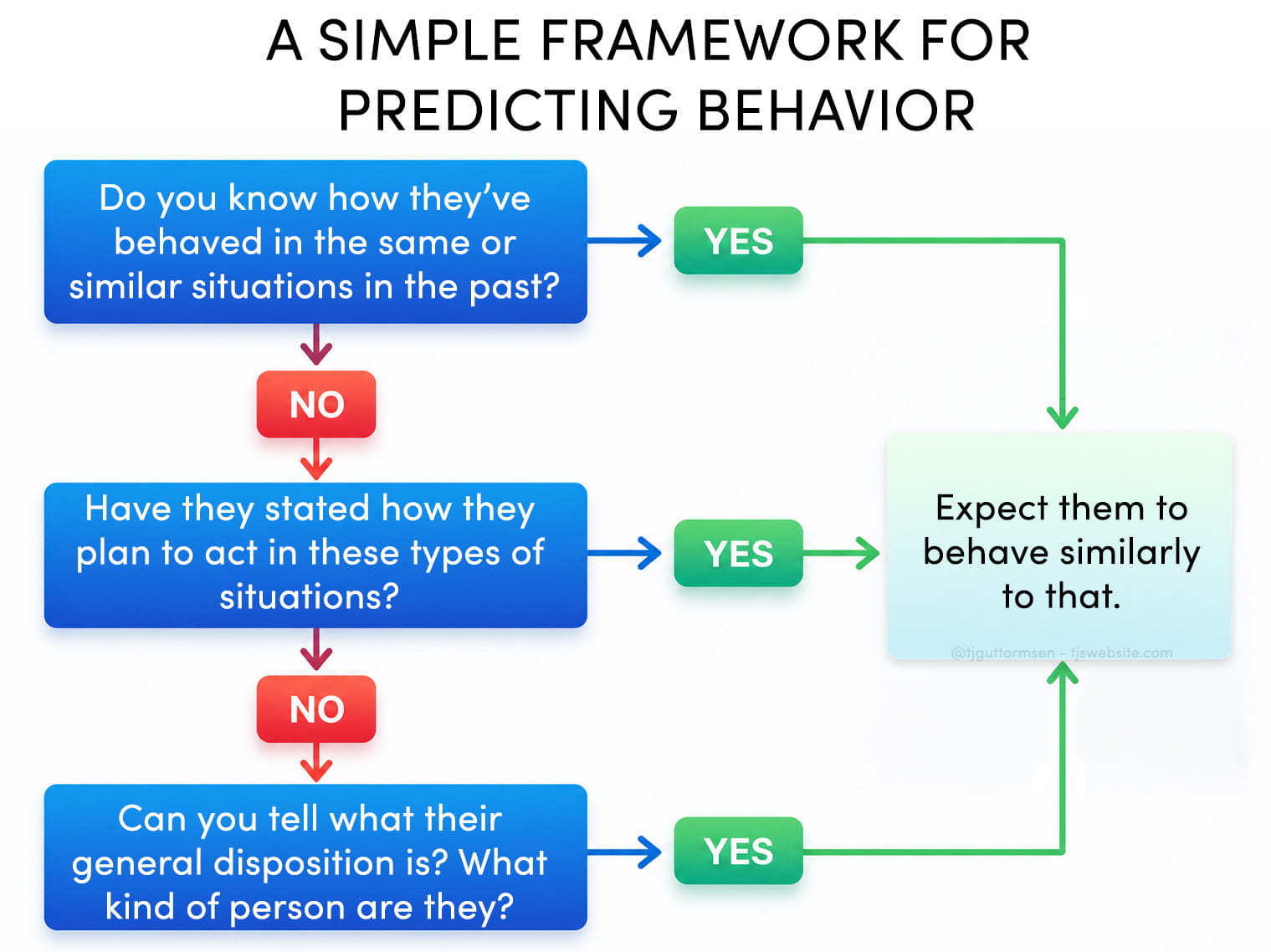
So this strategy is simple:
Each step is slightly less accurate than the previous, but all of them are far more helpful and accurate than letting your hopes or worries run the show.
Sources:
Ouellette, J. A., & Wood, W. (1998). Habit and intention in everyday life: The multiple processes by which past behavior predicts future behavior. Psychological Bulletin, 124(1), 54–74.
Sheeran, P. (2002). Intention–behavior relations: A conceptual and empirical review. European Review of Social Psychology, 12(1), 1–36.
Funder, D. C., & Colvin, C. R. (1991). Explorations in behavioral consistency: Properties of persons, situations, and behaviors. Journal of Personality and Social Psychology, 60(5), 773–794.
Epstein, S. (1979). The stability of behavior: On predicting most of the people much of the time. Journal of Personality and Social Psychology, 37(7), 1097–1126.
.svg)


Hi, I'm TJ Guttormsen.
Since 2009 I’ve coached clients ranging from Olympic gold medalists and billionaires, to people who simply want more out life.
I’ve done over 100 national media appearances, published books, and created online courses that have earned several “Highest Rated” titles from their 11 000+ members.
Today I coach clients from all over the world, and teach seminars for business and events from my home in Las Vegas.
Come join me in my Facebook group, follow my Instagram, or subscribe to my YouTube channel for fresh content on a regular basis.

